

Introduction
Large and complex construction projects across the United States are evolving at a pace that traditional systems were never designed to support. Whether it is high-rise commercial developments, mixed-use urban projects, healthcare campuses, transportation infrastructure, or large-scale EPC projects, the demands placed on project teams today are significantly higher than they were even a decade ago.
Schedules are tighter. Compliance requirements are stricter. Stakeholder ecosystems are larger and more fragmented. Design coordination has become more layered, and cost pressures continue to intensify.
In this environment, managing a project with disconnected workflows, static drawings, and siloed communication is no longer practical.
This is precisely why BIM Services have become central to how major construction projects are planned and executed. What was once viewed as an innovation is now increasingly seen as an operational necessity.
For large construction firms, EPC contractors, and infrastructure teams managing highly coordinated projects, BIM is no longer just about producing intelligent models. It has become a framework for improving decision-making, minimizing uncertainty, and creating greater control over project outcomes.
At ATA International Consulting Design Services (ATA ICDS), we have seen this shift firsthand. Through our BIM Design Support, along with specialized BIM coordination and clash detection services, we support project teams that need more than drawing, they need clarity.
Why BIM Services Matter More on Complex Projects
Complex construction projects rarely fail because of a lack of expertise. More often, they struggle because information breaks down.
A design revision may not reach all stakeholders at the same time. Mechanical systems may conflict with structural layouts. Procurement decisions may be made using outdated documentation. Site teams may discover coordination issues only after construction has already begun.
Each issue may appear manageable in isolation, but on large projects, these disconnects compound quickly. They lead to delays, rework, claims, budget overruns, and sometimes significant schedule disruptions.
This is where BIM Services in USA for construction projects have fundamentally changed the equation.
Rather than treating design, coordination, and execution as separate activities, BIM creates a shared digital environment where information is integrated, updated, and accessible across disciplines. Everyone from consultants and contractors to project managers and field teams works from a coordinated source of truth.
That shift alone changes how projects are delivered.
Instead of reacting to problems on site, teams can identify risks earlier, test scenarios digitally, and make informed decisions before those issues become expensive realities.
From Modeling to Project Intelligence
There is a common misconception that BIM begins and ends with 3D models.
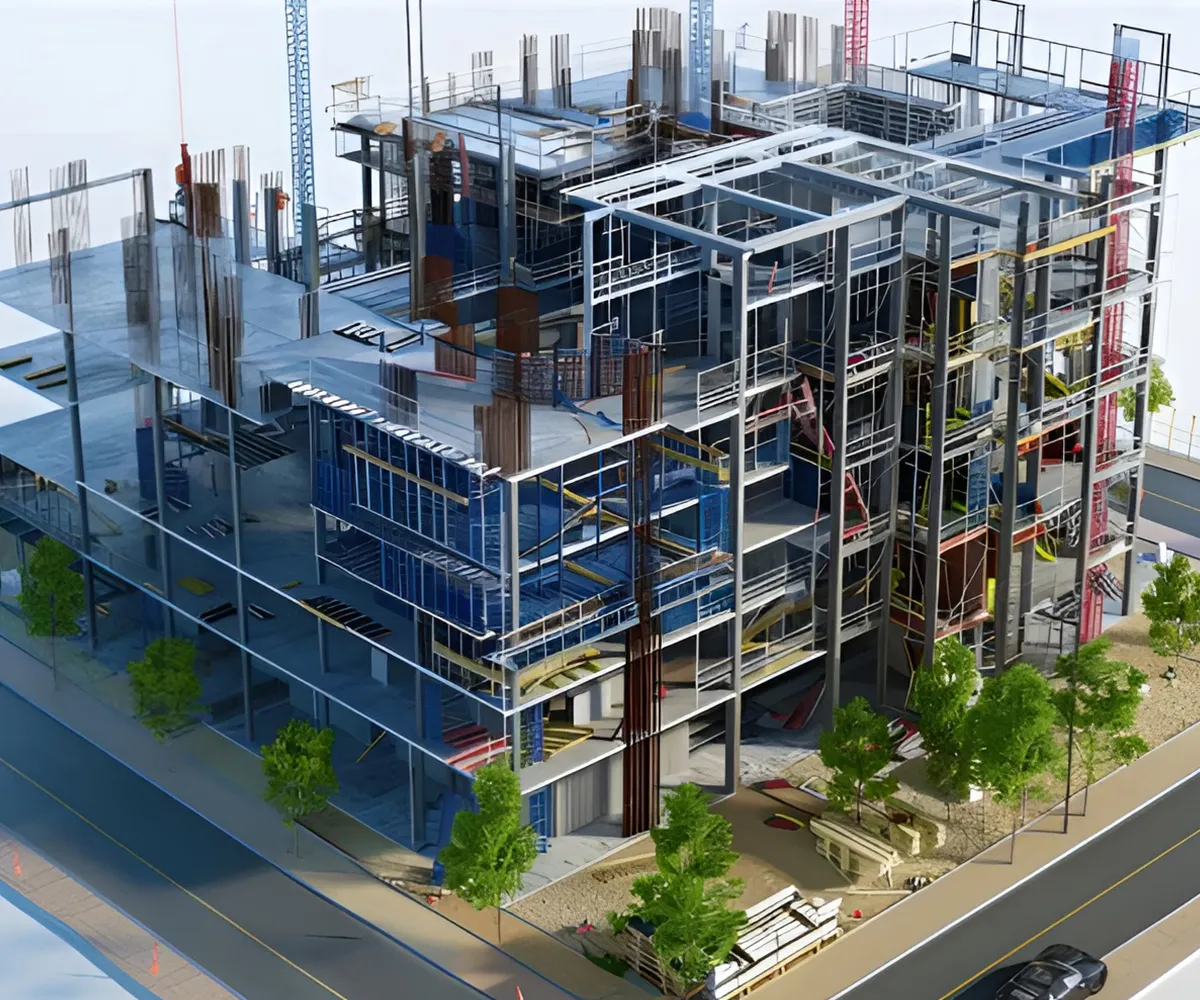
In reality, sophisticated BIM Services are much broader than modeling. They provide a digital ecosystem for managing complexity.
In large projects, that means integrating architectural, structural, and MEP systems into coordinated models, linking project schedules through 4D sequencing, connecting cost data through 5D BIM, and enabling real-time coordination between distributed teams.
What makes this particularly valuable on large-scale U.S. projects is the ability to move beyond visualization into predictive project management.
A coordinated model can reveal how a change in one discipline affects another. A sequence simulation can show how construction phasing impacts logistics. A clash detection review can uncover risks long before crews reach the field.
This is why BIM coordination services and BIM clash detection services are no longer viewed as support functions. They are increasingly central to project planning itself.
How BIM Services Are Transforming Project Execution
One of the most significant transformations BIM has brought to construction is in coordination.
On large projects, coordination is often where complexity becomes visible. Dozens of consultants, subcontractors, and project stakeholders must align technical information at a very high level of precision. Without structured coordination, friction is inevitable.
BIM enables teams to coordinate across disciplines in ways traditional documentation simply cannot.
Instead of discovering conflicts during installation, teams can identify them in the model. Instead of resolving issues through fragmented markups and RFIs, they can address them collaboratively in a shared digital environment.
That shift has enormous implications for risk.
BIM clash detection services, in particular, have transformed how construction teams approach problem prevention. Early detection of design conflicts reduces field changes, minimizes disruption, and protects both budgets and schedules.
For projects operating on thin margins or aggressive timelines, that is not a marginal improvement. It is critical.
Another major area of transformation is planning.
Large projects require extraordinary precision in sequencing, logistics, and resource allocation. BIM-linked scheduling allows teams to visualize construction activities over time, identify bottlenecks, and optimize workflows before site execution begins.
This 4D capability adds a layer of intelligence that static schedules alone often lack.
When cost data is integrated through 5D BIM, that intelligence expands further. Teams can evaluate how schedule shifts impact budgets, how design decisions affect quantities, and how procurement strategies align with execution plans.
This creates a much more proactive approach to project control.
Collaboration at Scale in Distributed Project Environments
Modern construction is rarely confined to a single office or location.
Large U.S. projects often involve globally distributed consultants, remote coordination teams, specialized trade partners, and multiple contractor layers operating simultaneously.
That level of distributed collaboration can create major communication risks if information is not managed consistently.
One of the reasons BIM services in USA continues gaining traction is their ability to support collaboration at scale.
Centralized BIM environments enable stakeholders across geographies to work from synchronized project data, reducing discrepancies and improving transparency.
That does not simply improve communication, it improves decision-making.
When teams have access to coordinated, current information, approvals happen faster, design intent is better preserved, and project execution becomes more predictable.
For large firms managing multiple active projects, this kind of alignment is increasingly non-negotiable.
Why BIM Outsourcing Is Becoming a Strategic Advantage
Another notable shift in the market is the growing use of BIM outsourcing services.
As projects become more complex, many construction firms are recognizing that maintaining all BIM resources internally can limit scalability.
Outsourcing BIM support allows firms to access specialized expertise, expand capacity during peak workloads, and accelerate deliverables without overextending internal teams.
More importantly, it allows project teams to focus internal resources on core execution while leveraging dedicated support for modeling, coordination, and clash resolution.
This is why BIM outsourcing services are increasingly viewed not simply as a staffing decision, but as a strategic one.
For many large firms, it has become a practical way to maintain quality while improving agility.
How ATA ICDS Supports Large Construction Projects
At ATA International Consulting Design Services, our BIM approach is designed specifically for the realities of large and complex construction projects.
Our BIM Design Support services focus on helping project teams improve constructability, coordination, and execution efficiency through intelligent, construction-ready modeling.
We support multidisciplinary BIM workflows that align with project-specific levels of development, support coordination reviews, and integrate seamlessly into broader project delivery frameworks.
Our expertise in BIM coordination services and BIM clash detection services allows teams to identify and resolve risks early, improving confidence before issues move into the field.
For high-rise developments, mixed-use projects, infrastructure assignments, and EPC-driven work, this level of support often becomes essential to maintaining project momentum.
We also recognize that BIM is not just about model delivery. It is about how those models support decisions.
That is why our focus remains practical. The goal is not to create sophisticated models for their own sake, but to create BIM deliverables that actively improve project outcomes.
The Real Impact of BIM on Project Performance
The strongest argument for BIM adoption is not theoretical. It is measurable.
Projects using well-executed BIM workflows consistently improve coordination quality, reduce rework exposure, enhance schedule predictability, and strengthen cost control.
Those gains may show up in fewer RFIs, fewer site conflicts, smoother sequencing, or improved stakeholder alignment.
But collectively, they point to something much bigger.
They show that BIM improves project resilience.
And in large-scale construction, resilience is often what separates successful projects from troubled ones.
Conclusion:
BIM Is No Longer the Future of Construction. It Is the Present.
Large and complex construction projects demand more than technical expertise. They demand systems capable of managing complexity intelligently.
That is exactly why BIM services in USA have become foundational to modern project delivery.
From improving coordination and reducing risk to enabling smarter planning and stronger collaboration, BIM is changing how construction projects are delivered across the U.S.
It is not simply a design tool. It is a strategic framework for execution.
With the right BIM Design Support, supported by robust BIM coordination and clash detection services, project teams gain something increasingly valuable in today’s construction environment: control.
And in projects where complexity is unavoidable, control is often the difference between disruption and successful delivery. At ATA International Consulting Design Services, that is where BIM creates its greatest value—not in the model itself, but in what it makes possible.